
Authority Will Not Sleep
The Legacy of the 2001 Authorization for Use of Military Force, Post 9/11 Combat Operations, and Ramifications for Iran

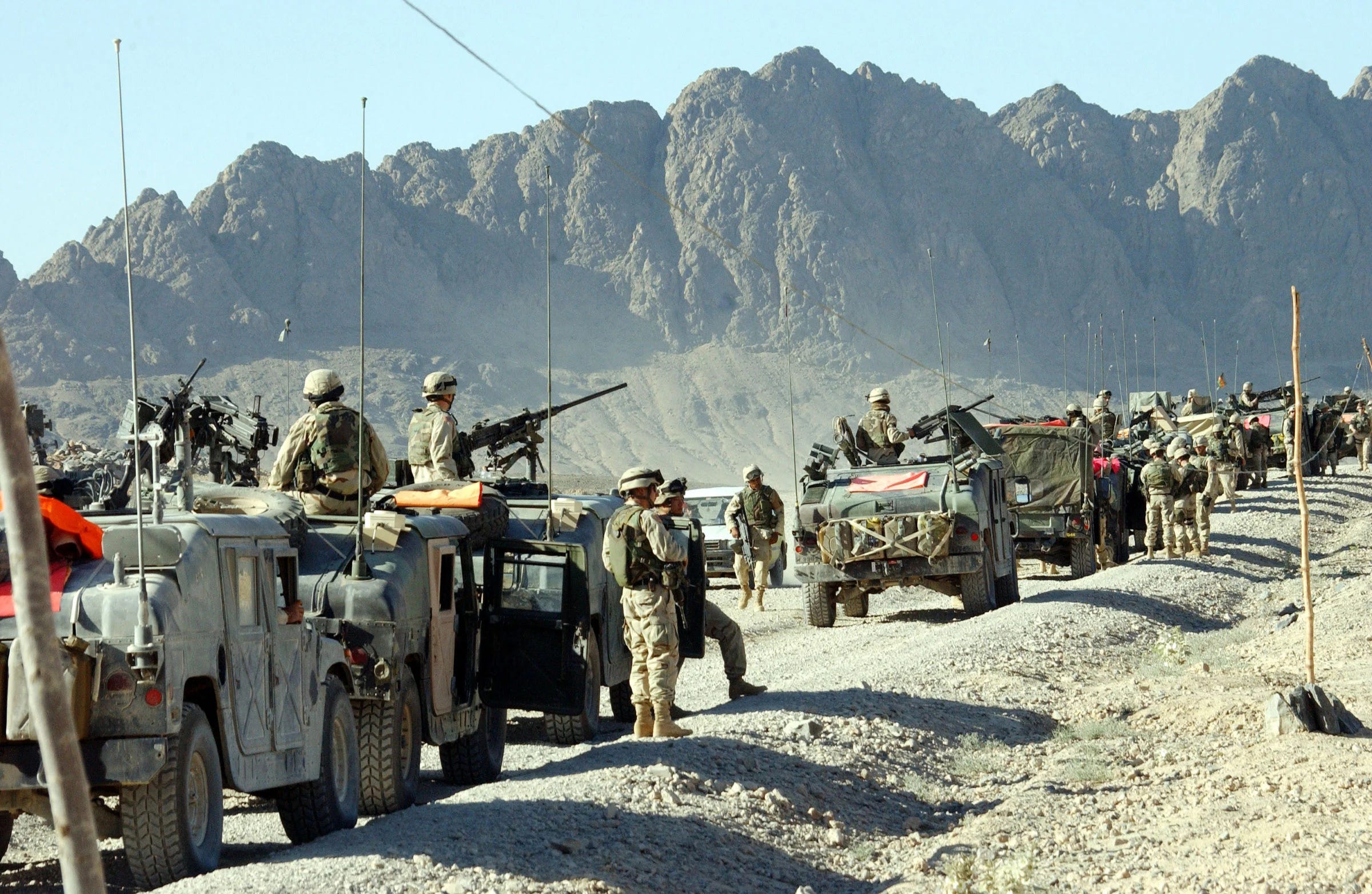
On September 14, 2001, three days after the towers fell, President George W. Bush signed Proclamation 7463 declaring a national emergency by reason of terrorist attacks. Four days after that, on September 18, he signed the Authorization for Use of Military Force (AUMF). The text of the AUMF runs sixty words. It authorizes the President to use “all necessary and appropriate force” against “those nations, organizations, or persons” he determines “planned, authorized, committed, or aided” the September 11 attacks, or harbored those who did. It does not name al-Qaeda. It does not name the Taliban. It does not specify a country, a timeline, or a sunset clause. It passed both levels of Congress almost unanimously, with Congresswoman Barbara Lee of California casting the lone dissenting vote.
In October 2002, a second AUMF was signed, this one specific to Iraq. Most of the surrounding legal architecture -the war powers reporting requirements, the Office of Legal Counsel opinions interpreting executive authority during ongoing hostilities, the renewal of the September 14 national emergency declaration- was built in the months and years that followed. Twenty-five years on, the architecture is still standing, but most of the lawmakers who built it are not in office. The architecture works without them.
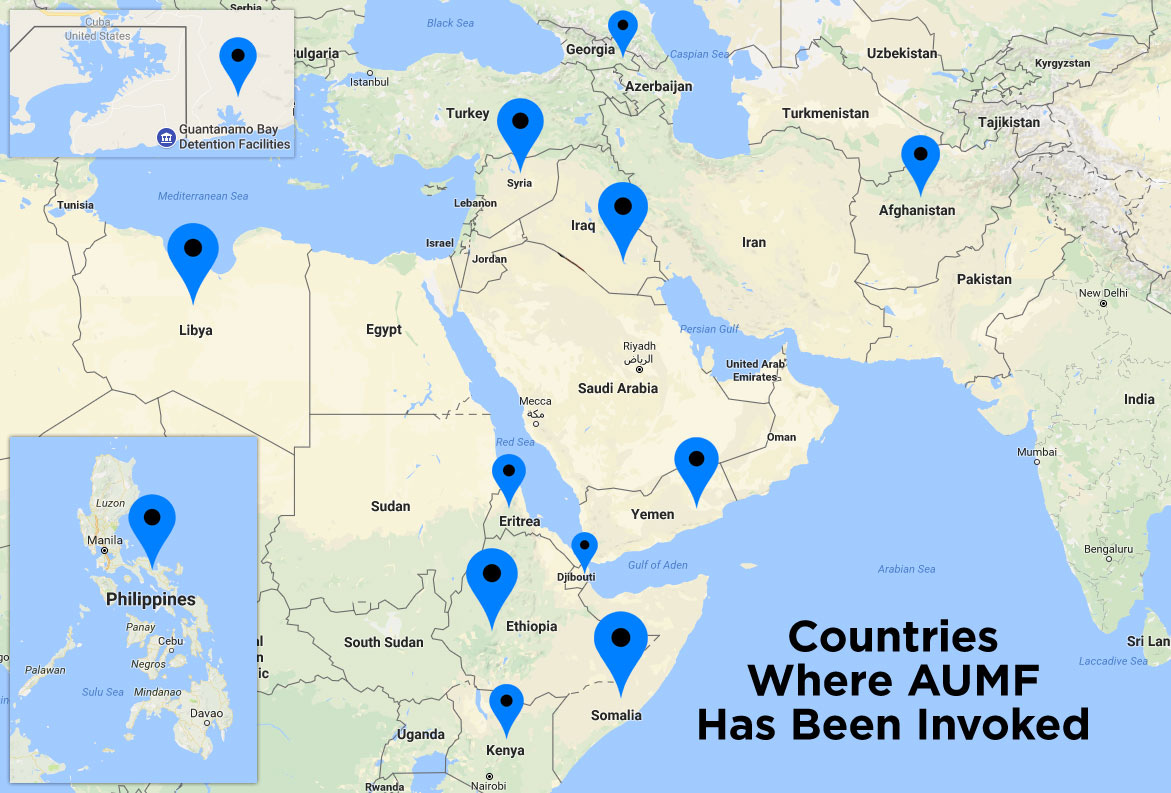
The 2001 AUMF has been cited as the legal basis for U.S. military operations in at least twenty-two countries, against at least eight distinct organizations, the majority of which did not exist when the authorization was granted. Al-Qaeda in the Arabian Peninsula, founded in 2009, was the named target of the 2011 strike that killed the American citizen Anwar al-Awlaki in Yemen. The Islamic State in Iraq and Syria, founded in 2013, was the named target of Operation Inherent Resolve beginning in 2014. The al-Qaeda affiliate in West Africa, the al-Shabaab network in Somalia, and the various successor organizations operating in Libya have all been cited as targets covered by the same sixty words. None of these organizations is named in the AUMF text. The legal bridge is a doctrine of “associated forces,” developed by executive branch lawyers across multiple administrations, that treats successor and affiliated groups as covered by the original authorization. Each citation has been issued by a different executive branch legal team. None has been overturned. The September 14, 2001 declaration of national emergency has been renewed by every president since -Bush, Obama, Trump 1.0, Biden, Trump 2.0- most recently in September 2025.
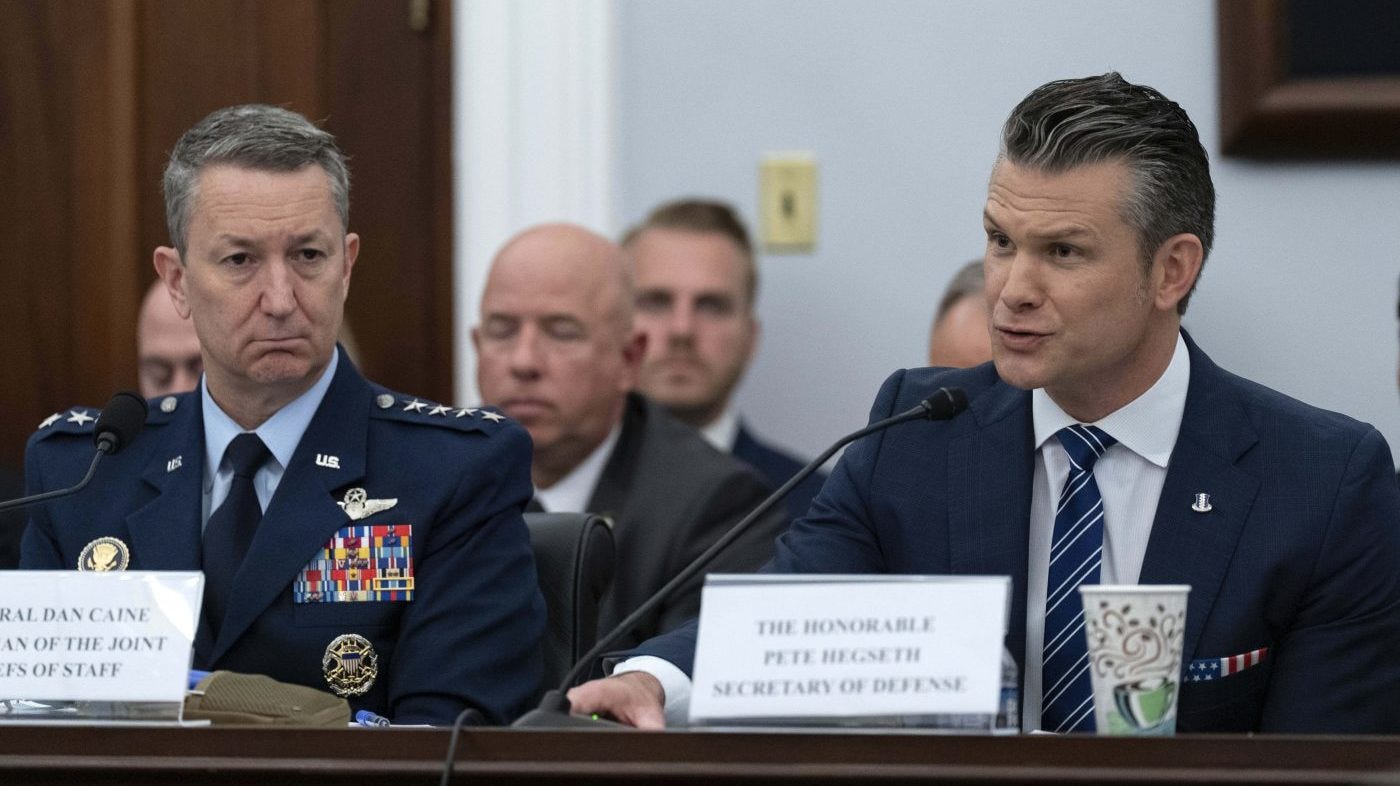
The War Powers Resolution of 1973, passed over President Richard Nixon’s veto in the aftermath of the secret bombing of Cambodia, was designed to address exactly this circumstance. It requires the President to notify Congress within 48 hours of introducing armed forces into hostilities, and to terminate the use of those forces within 60 days unless Congress has authorized the action or extended the deadline. Today, May 1, 2026, is the 60-day mark on the present U.S. military operation against Iran. President Trump notified Congress on March 2. The ceasefire between U.S. and Iranian forces took effect on April 7. Yesterday, in testimony before the Senate Armed Services Committee, Defense Secretary Pete Hegseth told senators that the administration’s understanding is that the ceasefire has paused the clock. “We are in a ceasefire right now,” he said, “which in our understanding means the 60-day clock pauses or stops in a ceasefire.”
The legal merit of that interpretation is contested. Senator Tim Kaine, Democrat of Virginia, told Hegseth at the hearing that he did not “believe the statute would support that.” Senator Thom Tillis, Republican of North Carolina, said he believed the 60-day mark required Congress to act and vote to continue combat operations, or end them. Katherine Yon Ebright of the Brennan Center for Justice told CBS News that the War Powers Resolution does not, by its text or design, accommodate a ceasefire-pauses-the-clock reading. However, she added that there is “a long history of executive branch lawyers willfully misinterpreting the War Powers Resolution to allow presidents to conduct hostilities even past that 60-day clock.” That history is bipartisan. The Obama administration argued in 2011 that air strikes against Libya did not rise to the level of “hostilities” within the meaning of the War Powers Resolution. The George H.W. Bush and George W. Bush administrations both obtained authorizations for their respective wars against Iraq, but both argued they did not need them. President Clinton kept troops in Kosovo past the 60-day mark in 1999 by arguing that congressional appropriations for the deployment constituted implicit authorization. Every president since the War Powers Resolution was passed has, at some point, declined to be bound by it. None has been overruled.
This is the part of the story worth examining. The 2001 AUMF was passed with the expectation, on the part of most members of Congress who voted for it, that it would authorize a specific action against a specific enemy. Twenty-five years later, the authorization outlived the enemy, the planners, and most of the legislators. The September 14 national emergency declaration that accompanied it has been continuously in force longer than the average American adult has been alive. The War Powers Resolution that was supposed to constrain the use of authority has been treated, by every administration that has encountered it, as a guideline rather than a binding statute. The cumulative effect of these three institutional facts operating together for twenty-five years is a structure in which the executive holds, in practice, an authority to use military force that is bounded only by the executive’s own forbearance.
The pattern, as a general matter, is not a story of any single administration acting in bad faith. It is a story about an institutional framework operating exactly as it was structured to operate. A grant of authority that does not specify a sunset, an enemy, a geography, or a triggering criterion cannot, by its own terms, expire. A statute designed to constrain the executive that depends on the executive to apply its own constraints will, over time, be applied as the executive sees fit. A Congress that finds it politically costly to vote against a specific use of force, but politically uncostly to leave a generic authorization on the books, will leave the authorization on the books. Each of these institutional facts is, considered in isolation, defensible. The accumulated structure they produce is the one the country is operating under right now.
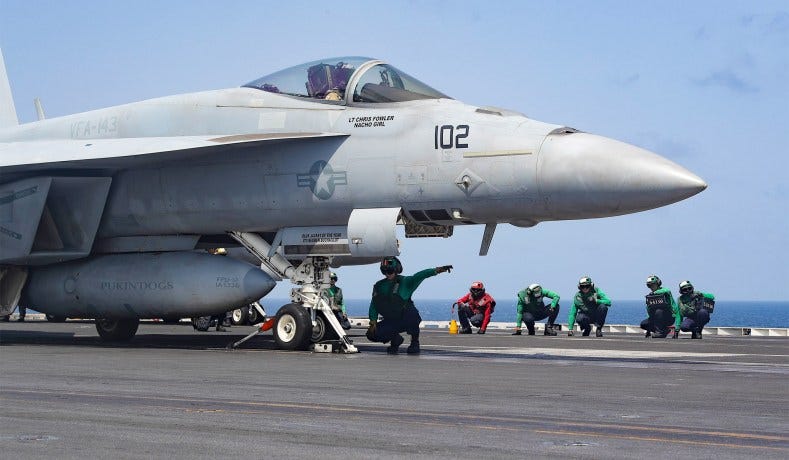
The cost of that structure is paid in part by the institution that operates within it. A military whose legal authority to act is permanent, whose enemy is defined as the successor of a successor of an enemy now twenty-five years dead, and whose deployment timeline is set entirely by the executive must plan, equip, and posture itself for a permanent state of readiness. Special operations forces are currently rotating through dozens of countries on missions authorized by various combinations of the 2001 AUMF, the 2002 AUMF, and Article II of the Constitution. Carrier battle groups are maintaining a naval blockade in the Strait of Hormuz under the same combined authorities. Reserve components are on activation cycles that, in some specialty fields, have not meaningfully paused since 2003. The cost of standing readiness is not only financial. It is paid in retention rates, in family separation, in the gradual erosion of the volunteer force’s depth at the levels that matter most. The Brown University Costs of War project estimates the total fiscal cost of the post-9/11 wars at roughly $8 trillion, a figure that includes projected veterans’ care obligations through 2050. The institution that bears this cost has very little voice in the legal framework that determines it.
Whether the 60-day clock has paused or expired or reset is a legal question that will likely be resolved the way the previous fifty years of such questions have been resolved: not in court, not by vote, but by the passage of time and the next news cycle. Whether the underlying framework is the framework the country wants to operate under for the next twenty-five years is a different question.