
The Ukrainian Comeback
How Volodymir Zelenskyy and Ukraine Regained the Momentum from Russia in the First Months of 2026

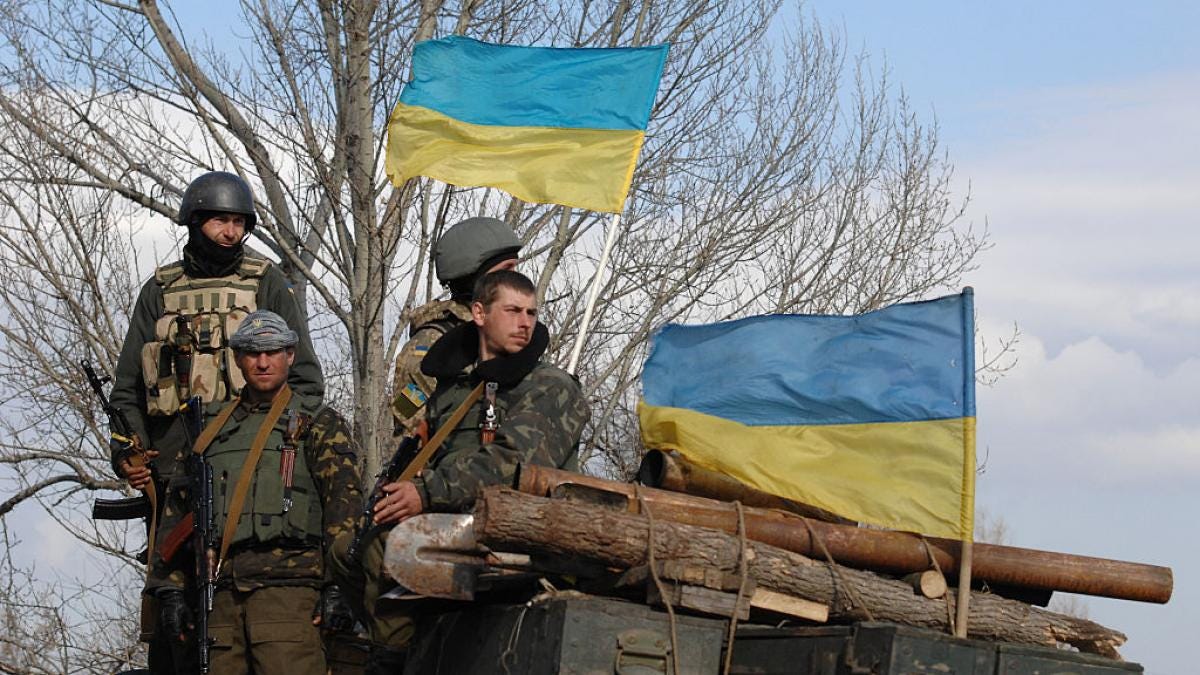
In early 2025, Ukraine was not in a good spot. The political climate in Washington had shifted against Kyiv, and continued American support was openly in question. Russian forces were grinding forward in the eastern oblasts. And in November 2025, Operation Midas - a $100 million kickback investigation into Ukraine’s state nuclear operator Energoatom - implicated figures inside Volodymyr Zelenskyy’s inner circle, eventually costing him both his Justice Minister and, in late November, his powerful Chief of Staff Andriy Yermak. The damage done was real, and it landed at the worst possible moment - with millions of Ukrainians sitting through eight to eleven hours of daily blackouts caused by Russian strikes on the same energy infrastructure being looted by Ukrainian oligarchs.
Now, four years into a war that has decimated their country and depended on international aid for much of its survival, Ukraine just had its best month since the full-scale invasion began in February 2022.
Battlefield Gains & Advancements
For most of 2025, Russia held momentum on the ground. Ukraine has not reversed that momentum, but rather disrupted it.
In February and March 2026, Ukrainian forces conducted simultaneous counterattacks across multiple sectors from Kupyansk in the northeast - where Ukraine retook over 180 square kilometers between mid-December and late December alone, to the Hulyaipole–Oleksandrivka axis at the junction of Dnipropetrovsk and Zaporizhzhia oblasts. The Institute for the Study of War (ISW) assessed that the compounding pressure forced the Russian command to redeploy elite VDV and naval infantry units from Donetsk Oblast, compromising Russia’s anticipated Spring–Summer 2026 offensive against Ukraine’s Fortress Belt before it begins. The Adapt Institute estimates Ukraine recovered roughly 257 square kilometers between January and early March 2026.
That number needs context. Over the same general period, Russia is still net-advancing in territorial terms - ISW data shows Russian forces seized roughly 1,929 square kilometers between October 2025 and March 2026. Ukraine’s success has not been in retaking ground at scale. It has been in degrading the conditions Russia needs to sustain its advance into 2026, and in forcing Moscow to spend forces it had reserved for the next offensive on stabilizing positions it expected to hold cheaply.
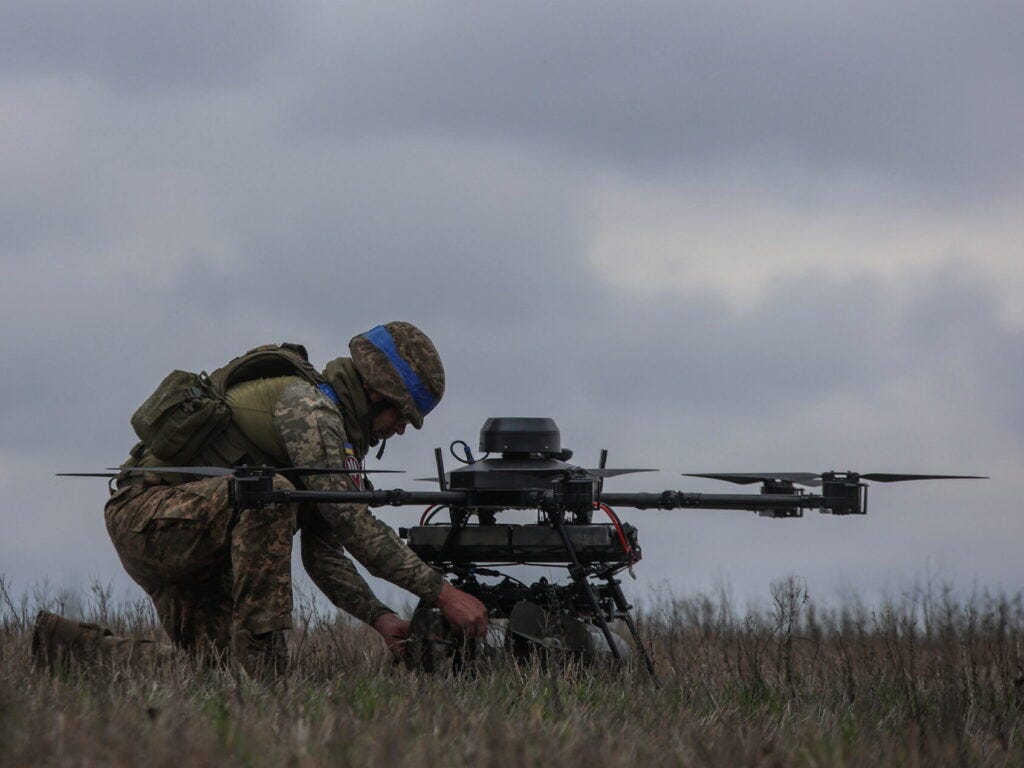
The technological story underneath the territorial story is the more important one. On 1 June 2025, Ukraine’s Security Service launched Operation Spiderweb: 117 FPV drones smuggled into Russia inside wooden cabins on cargo trucks, launched from Russian territory, striking five strategic bomber bases stretching from Olenya in the Arctic to Belaya in eastern Siberia - more than 4,000 kilometers from the Ukrainian border. Ukrainian sources claim 41 aircraft damaged or destroyed and approximately $7 billion in losses. Russian media themselves reached for the Pearl Harbor analogy. But the strategic effect was less the destroyed aircraft than the demonstration that nowhere inside Russia is operationally untouchable. Within days, satellite imagery showed Russian airfields hurriedly building shelters and relocating bombers.
A Decisive European Election
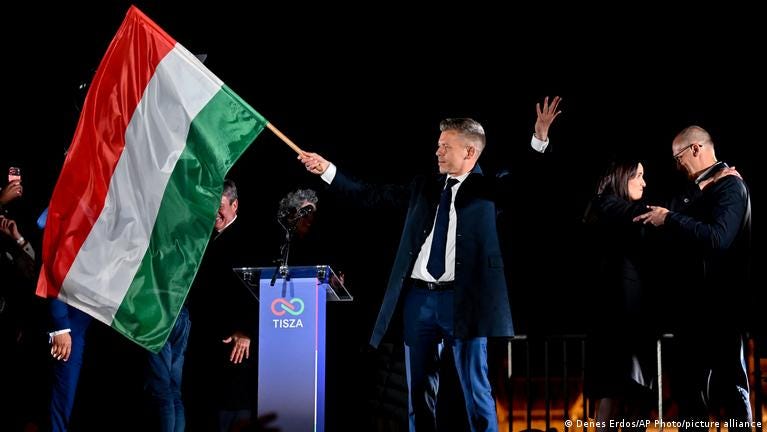
For sixteen years, Viktor Orbán was the most reliable pro-Russia voice inside the European Union. On 12 April 2026, that ended. Péter Magyar’s center-right Tisza Party defeated Fidesz in a landslide, taking a constitutional supermajority on roughly 54 percent of the vote against Fidesz’s 38 percent. Orbán conceded that night, after the highest turnout in Hungary’s post-Communist history.
The immediate consequence for Ukraine was the unblocking of the European Union’s €90 billion support loan, which had been agreed at the European Council on 18 December 2025 but held hostage by Hungary’s veto for two months. On 23 April 2026, the post-election Hungarian government lifted the veto, and the loan - €60 billion for defense and €30 billion for budget support, repayable only when Russia pays war reparations - was approved. Hungary, Slovakia, and Czechia opted out of backing it, so the deal proceeded under the EU’s enhanced cooperation procedure with twenty-four member states underwriting roughly €3 billion in annual interest costs.
Magyar is not as instinctively pro-Ukraine as his EU peers, and the proximate cause of the unlock was as much energy-pragmatic as political - Ukraine had repaired the Druzhba pipeline, restoring Russian oil flow to landlocked Hungary and Slovakia. But the result is that Ukraine’s most reliable European saboteur is gone, the funding is moving, and the political space for the next round of European support is wider than it has been at any point in the war.
Consultation on the World Stage
Ukraine has become a valuable international partner with real teeth and leverage.
In February 2026, four Ukrainian defense manufacturers signed framework agreements with companies in Denmark, Finland, and Latvia under the “Build with Ukraine” model, with a notional value of approximately €800 million. Ukraine has now signed bilateral defense quality-assurance memoranda with Germany, France, Sweden, Norway, Poland, Czechia, and Türkiye, with the United Kingdom, Italy, Denmark, the Netherlands, and Slovenia in active negotiation. Ukrainian-designed drones are being produced in Germany. Ukraine has opened arms export offices in Berlin and Copenhagen. The country that two years ago was a recipient of European weapons is now supplying European production chains, with a stated goal of producing seven million drones in 2026.
Then came the unexpected leverage. On 28 February 2026, the United States and Israel launched Operation Epic Fury against Iran. Iran retaliated with the Shahed-family loitering munitions it has been firing at Israel and at U.S. and Gulf targets — the same Iranian-designed weapons, and their Russian Geran-2 derivative, that Russia has used to terrorize Ukrainian cities almost nightly since September 2023. Suddenly, the country with three and a half years of accumulated experience in shooting Shaheds out of the sky had something every Gulf monarchy needed.
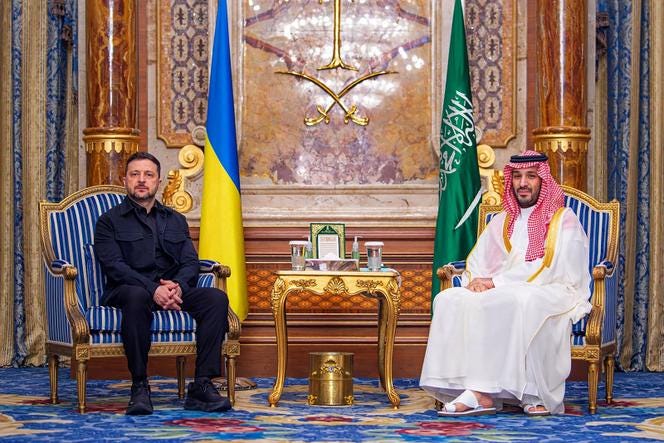
Between 26 March and 5 April 2026, Zelenskyy made a regional tour that would have been unthinkable a year earlier: Saudi Arabia, the United Arab Emirates, Qatar, Jordan, and Damascus. He signed 10-year defense cooperation agreements with Saudi Arabia and Qatar, with a similar UAE arrangement under finalization. By the time of the trip, Ukraine had already deployed more than 200 counter-drone specialists to the region, with thirty more headed to Jordan and Kuwait. The framework is straightforward: Ukrainian expertise and cheap interceptors in exchange for funding and access to the more expensive Western air-defense missiles Ukraine needs to survive its own nightly Russian barrages.
The Damascus stop carried the heaviest symbolic weight. Syria spent decades hosting two major Russian military bases and depending on Russian arms; Bashar al-Assad fell in late 2024, Ahmed al-Sharaa now leads the country, and Zelenskyy’s visit on 5 April 2026 - his first since diplomatic ties were restored in September 2025 - produced a pledge of mutual security cooperation. A country that was a Russian client state for fifty years is now exchanging military expertise with the country Russia is trying to destroy.
Even the United States - whose officials had publicly questioned the value of Ukrainian help - has quietly relied on Ukrainian counter-drone specialists in coordinating Gulf air defense during Epic Fury. The work happens in operational silence, but it happens.
The cards
In February 2025, the conventional wisdom in Washington held that Ukraine “didn’t have the cards.” It was, in fairness, a defensible read of the moment. American patience was visibly thinning. Russian forces were advancing. The political weather across the West was turning. The corruption scandal was still ten months away from breaking, but the rot it would expose was already there.
Since then, Ukraine has gained a lot more of the leverage needed to convince Washington he is winning.
The most reliable pro-Russia government inside the EU has been replaced. The €90 billion loan is moving. Ukraine has reversed Russian gains in multiple sectors and forced Moscow’s command to cannibalize its planned summer offensive before it begins. Ukrainian drone manufacturers are production partners across Europe. Gulf monarchies are paying for Ukrainian counter-drone expertise. A post-Assad Syria is signing cooperation agreements with Kyiv. And the country that fifteen months ago was being told it had no leverage is now, quietly, being asked for help by some of the same allies who told it that.
The war is not over. The Russian Spring–Summer offensive is still coming. The Mindich scandal has reshaped Ukrainian politics in ways that will take years to settle. Patriot interceptor stockpiles are dwindling across the West, and every missile fired in defense of a Riyadh power station is one not available to defend a Kharkiv apartment block. None of this is a victory.
But Zelenskyy was told he didn’t have the cards. As of this month, he does.